


Blog
Is Your Sales Training a Revenue Driver or a Budget Leak?



The 7 Questions Every Revenue Leader Must Answer
Sales training has never been more accessible.
A few minutes of research will reveal there is now more content available, more channels of delivery and greater focus on developing capability across organisations than ever before. Yet many Chief Revenue Officers and Sales Leaders are still asking the same fundamental question:
Why doesn’t sales training deliver more consistent, measurable impact?
In our experience, the issue is rarely motivation or budget. Most organisations recognise the benefits of investing in developing their sales capability. The problem is more fundamental: training is still treated as an event, not a transformation system.
Too many organisations still expect sales training to create behaviour change on its own. A programme is designed, delivered, well received, and then…quietly left to compete with the realities of the field. Sellers return to full pipelines, short-term targets, and familiar, comfortable habits. In this environment, even high-quality training, in isolation, will struggle to prevail.
In 2026, maximising sales training ROI should not simply be about running more programmes or introducing better content. It should be about building an ecosystem around training that drives sustained behavioural change.
Highly effective sales organisations consistently demonstrate seven key disciplines that elevate training beyond being an inspiring event and into real-world transformation.
These habits are observable, diagnosable, and directly linked to whether training translates into improved execution and revenue performance.
1. Engagement
High impact sales training captures the focus and attention of its participants.
Training sticks when sellers understand why change matters, what is expected of them and how success will be reinforced after the ‘training’ ends.
Effective engagement is driven by:
- Clear recognition of how the training benefits the individual, their customers and the business
- Explicit links between learning and individual performance outcomes
- Blended learning approaches that combine workshops, virtual sessions, on-demand content, and coaching
- Interactive elements that encourage participation, not passive consumption.
Engagement is a gateway to adoption. Without it, ROI is impossible. However, engagement without reinforcement can still lead to regression. More on that to come…
2. Relevance
High impact sales training should reflect the reality sellers face every day.
Generic, ‘off-the-shelf’ training content, tools and approaches are often seen as not relevant by learners and therefore easier to ignore.
High-impact programmes are:
- Tailored to specific sales roles and experience levels
- Grounded in real markets, customers, and deal mechanics
- Aligned to business priorities.
Relevance creates a compelling context for the learner to engage. But relevance alone does not drive transformation. It must be reinforced through real work, real deals, and real expectations after delivery.
3. Customer Focus
There’s nothing wrong with having a defined sales process. Yet, too many sales training programmes are inward focused. It’s focused on products, sales steps, internal processes. But what about the customer?!? Too much sales training fails to recognise that to sell, the customer has to want to buy. This can result in our approach becoming seller-centred rather than buyer-centric. In turn this can all too quickly create a disconnect between the behaviours promoted in training and the reality of the customer’s world.
High-impact training:
- Aligns sales behaviours with the customer decision-making journey
- Encourages commercial, strategic, and value-based customer conversations
- Enables sellers to create differentiation beyond the product or service they are selling.
When training reflects customer behaviour, it gains credibility. When it does not, sellers may meet resistance to their approach.
4. Real-World Application
High impact sales training is built around application, not theory.
Demonstrating skills in a workshop is a great development step – but it’s only one part of the change equation. Transformation happens when those skills are applied, reviewed and reinforced in live selling situations.
Best-practice organisations:
- Use real customer scenarios and live deals during training
- Set clear expectations around application and accountability post-training
- Create an environment where sellers can apply their learning immediately
- Track evidence of real-world application.
Without ongoing application, training remains an event. With it, training becomes a performance driver.
5. Sponsorship
High impact sales training is visibly sponsored and reinforced by leadership.
When training is positioned simply as an L&D initiative, it becomes optional under pressure. When it is positioned as a commercial priority, behaviour change follows.
Strong sponsorship means:
- Senior leaders consistently reference the training in business conversations
- Managers coach against the frameworks and behaviours learned, beyond the training
- Expectations around approaches learned and tool usage are reinforced through pipeline, deal, and account reviews
Sponsorship is what connects training to the day job. Without it, even the best-designed programmes lose momentum.
6. Sustainability
High impact sales training is embedded into the way the organisation operates.
Learning does not stick just because content is memorable. Learning sticks because systems, processes and coaching reinforce it consistently over time.
Sustainable training:
- Is reinforced through regular coaching and application reviews
- Is embedded into CRM and workflows with just-in-time prompts and tools
- Creates shared language and frameworks across the organisation
- Extends beyond sales into the wider revenue ecosystem (Marketing, Product, Pricing)
Sustainability is not about keeping training alive.
It is about making new behaviours the default way the organisation sells.
7. Measurement
Most sales teams measure training activity – attendance figures, trainee satisfaction scores, etc. However, attendance and satisfaction scores do not equate to ROI. Behavioural change that drives improved performance does.
High-performing sales organisations measure:
- Observable changes in selling behaviour
- Impact on deal volume, quality and execution
- Contribution to commercial outcomes.
If you cannot evidence measurable impact, you cannot optimise training or justify further investment.
The Real Questions Every Revenue Leader Should Be Asking In 2026
Experience tells us that for some, maximising sales training effectiveness will require a fundamental mindset shift.
High-performing organisations don’t ask, “Did we run the training?”
They audit the foundations that drive permanent behaviour change and revenue growth, asking questions like:
- Is training supported before and after delivery?
- Are leaders reinforcing the expected behaviours?
- Are systems and processes aligned to the new ways of working?
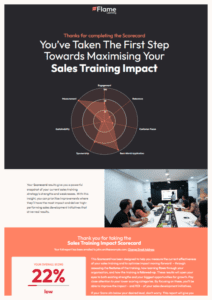
These are precisely the type of issues our Sales Training Impact Scorecard is designed to surface.
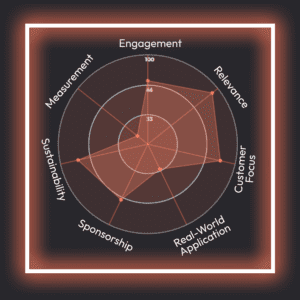
The Scorecard benchmarks your organisation’s approach across the seven key disciplines mentioned:
Engagement. Relevance. Customer Focus. Real-World Application. Sponsorship. Sustainability. Measurement.
The questions you respond to are not theoretical. They identify the difference between training that simply stimulates and training that truly performs.
The Sales Training Impact Scorecard provides:
- A clear view of where your current training approach is truly driving impact
- Visibility into where ROI is leaking
- Practical direction on what to fix first.
Don’t Spend Another Penny Blind
Complete the Sales Training Impact Scorecard and establish a clear baseline.
Know what is working.
Know what is not.
Know where to focus next.
The sales organisations that win in 2026 won’t necessarily train more. They’ll build the systems that make training stick.
Get your personalised Sales Training Impact Score and Report today.
📩 Book your free Sales Training Strategy Session now.
🔥 Learn more: https://flamelearning.com
📬 Pitch Perfect: Subscribe for regular insights and practical resources